4 May 2026 · Bank Eakasit · 6 min read
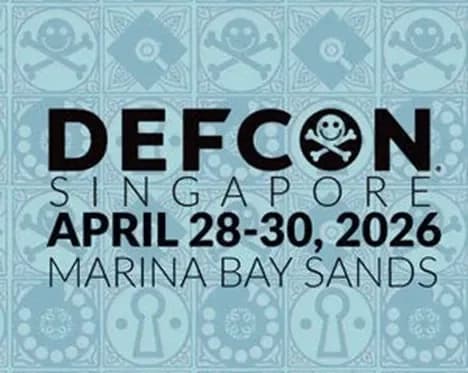
DEFCON is a hacker convention held annually in Las Vegas. This year, it was also held in Asia, in Singapore, on 28 to 30 April. My company booked my attendance in late March.
Overall, DEFCON SG 2026 was a very nice event. The price was good, travel was easy, and I enjoyed walking around even though I missed many opportunities due to time constraints. I hope this event will be held annually.
I’ve arrived on the second day of the event. I missed the first day (Tuesday) because of work, flew at night. The flight got delayed and we reached the hotel by 5 am on Wednesday… ugh. I woke up and got to the event around 11 am-ish.
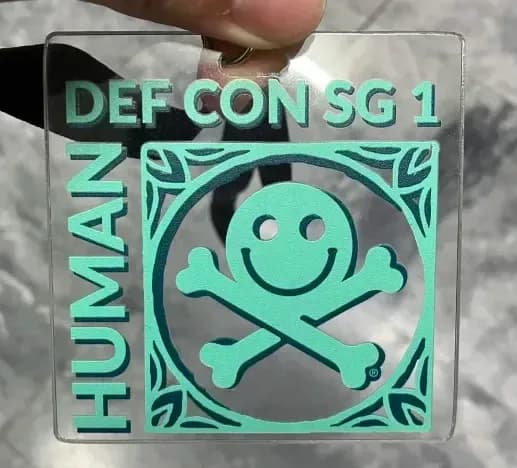
Biggest shock: there were no electronic badges left!!? What the heck. I had a ticket but no badge. Did DEFCON get overbooked or what? 😂 I suggest anyone attending should probably have someone register on their behalf early to avoid this. I’m not a hardware guy anyway, it’s purely psychological feeling neglected.
Before noon, I walked around to explore the different areas. The venue was huge, with many villages and communities, including div0 (Singapore), SherpaSec (Malaysia), NUS Greyhats — University of Singapore CSA, OWASP, ISC2, and many others. Additional villages included the Car Hacking Village, ICS Village, Hardware Village, Cryptocurrency Village, Maritime Village, and The Range Village, among many more. I didn’t have enough time to visit all of them. I’ve heard that DEF CON in Las Vegas is at least ten times larger!!?
I started with C517 Village talking about mobile JSB (JavaScript Bridge) mid-talk. This vulnerability is becoming quite popular. It’s basically an API that developers implement for a webview to call back to the Android native side.
In the afternoon, the first session I attended was about an industrial tool proposed by a well-known SecGuy admin. The topic was “Oblivion Token.” Honestly, it didn’t feel like a tool demo, it was more like explaining how Microsoft’s MFA and token design are pretty messed up. In short, the MFA is skip-able by default and the refresh token can be used to issue the JWT for ms-graph API. The refresh token is even shared across several applications in the same family (FOCI). From my perspective, it’s a bad design that forces operators to do their own security tuning and may not be intuitive which leads to incorrect and missing security configurations. Then the team proposed a tool to help detect issues afterward.
After that, I visited various booths and villages. First was post-quantum (pQCee was there selling tools for discovery and inventory), biohacking (medical device testing — it was too crowded, will check again tomorrow), and aerospace (Aerospace!! woooo). They had hands-on demos, controlling a mini helicopter via terminal commands. The idea is that the terminal command may have bugs either logical or buffer-overflow. As an attacker, we could exploit these bugs to force the helicopter to execute dangerous actions causing it to go boom. In this example, they were missing the boundary check in the debug mode which was also accessible through the commands.
Another section in the same village was the satellite research team. I got to chat with them about system architecture, layers, encryption layers, and typical testing methodologies. The satellite system is usually based on the CCSDS system which is the open source framework provided by NASA to handle both the ground system and the satellite. I imagine this framework to be comparable to the RFC network protocols. This layer includes packet framing and security check (e.g. firewall to handle encryption and prevent replay attack, etc.) before delivering the message to other functional systems. The tests are usually whitebox but blackbox is also possible though it’s complicated starting with frequency and channel discovery.
Then I went back to another open-space session at C517 Village. This time about a V8 exploit (CVE-2025–5419) caused by false dead code elimination. Super interesting that the JIT compiler incorrectly assumes it can optimize away certain lines of code, even though those lines are actually needed, which leads to a bug. The bug was both beautiful and ugly at the same time.
After that, I joined a main hall session about RCE via a spam filter. I arrived late, so I missed the entry point. When I got in, they were already talking about persistent technique using ptrace and system calls.
The last session of the day was about Microsoft Entra ID. They talked about some applications using mutable claims like email as identity which is wrong. This issue has been known since 2023, and Microsoft already put big warnings in their docs. Another issue involved overriding JWT validation functions in a .NET library, causing JWT signature checks to be skipped. Overall, I think the JWT issues mentioned here are easy to detect (even Burp scan can find them), while the chance of encountering them in the wild is quite low. In my opinion, this session was primarily focused on raising awareness.
On 30 April (last day), I started with the biohacking village. This one was funny, the owner provided us with a biomedical device (some kind of pump something) but they didn’t know how it worked either. Looks like no one can connect to the device lol. My guess was that the device was broken because there was no network broadcasting packet from the device at all — even after changing interfaces and broadcasting into nothingness. But I enjoyed it nevertheless. We were able to take a full look at the device and surprisingly there was an ethernet port on these devices.
Later I joined the main session on AI Prompt Injection. An interesting takeaway for pentester is that the legacy prompt injection is now obsolete because the model has been taught to give these instructions low priority. However, the attack has shifted to something more fraud-like. The tester may act like a scammer targeting customer support, shifting the focus to bypassing business logic, deflecting the security instructions rather than trying to override them directly.
In the afternoon, I stuck to the C517 village playing both air-gap CTF and malware reversing. This air-gap was not a complete air-gap, but the idea was that data flow from the attacker’s input was one-way into the internal system zone (going through malware scanning, firewall, and batch processing), controlled by a diode node. However, the high-security network behind the diode still processed this untrusted data and responded through another channel (Also via diode flowing from internal zone to external zone). The CTF involved blind RCE and blind exfiltration. It wasn’t hard, but I was confused by the second-level instructions, and the third level required brute-forcing, which I initially hesitated to do. Remember: everything in this session is “blind”. You don’t see what happens on the backend.
Then I continued with malware reversing. It wasn’t too difficult because the staff showed us how to use AI to help with the process, although their AI had limited context. We didn’t have enough time to complete the third level, so we missed the premium black badge by an inch. We probably should have started this village on the second day.
My colleagues won first place in the Maritime Hacking Village CTF. They’re the real bosses!! 😄
Overall, it was very enjoyable. 2–3 days was not enough to visit every booth, villages and main sections. See you next time DEFCON.
- 4 May 2026 -