
Professional service
Security Assessment and Penetration Testing
This service included Red Teaming, Penetration Testing, and Vulnerability Assessment. Our methodology is developed based on various of penetration testing framework and standard including OWASP, iPentest, NIST and Cyber Kill Chain for our methodology.
Advanced security testing
Testing that mirrors a real adversary
Five services, from red teaming to deepfake and liveness testing. Select one to read what it involves.
- 01Red Teaming & Breach and Attack SimulationSee details
Objective-based attack scenarios that measure your organisation’s real ability to prevent, detect and respond to a determined adversary.


Why it matters
Advantages
01
Identifying Vulnerabilities
Security assessments and penetration testing help in identifying vulnerabilities and weaknesses in systems, networks, and applications before attackers exploit them. This allows you to address these vulnerabilities before they can be used in a cyberattack.
02
Risk Reduction
By uncovering vulnerabilities and weaknesses, organizations can take proactive measures to mitigate risks and strengthen their overall security posture.
03
Compliance
Many regulatory requirements and industry standards mandate regular security assessments and penetration testing. Conducting these tests helps organizations demonstrate compliance with these standards and regulations.
04
Cost Savings
Identifying and addressing security vulnerabilities early on can help prevent costly data breaches and other security incidents. Investing in security assessment and penetration testing can result in long-term cost savings by reducing the likelihood of security incidents.
05
Third-party Assurance
Organizations often engage third-party security experts to conduct security assessments and penetration testing. The findings and recommendations provided by these experts offer an independent validation of the organization’s security measures, assuring stakeholders and customers.
06
Simulates real-world attacks
Penetration testing and Red teaming go beyond just identifying vulnerabilities. It simulates real-world attacks to test the effectiveness of your security controls and identify how an attacker might try to exploit weaknesses. Through simulated attacks and assessments, organizations can evaluate the effectiveness of their incident response plans and procedures, and refine and improve their response capabilities.
07
Continuous Improvement
Security assessments and penetration testing are not one-time activities but ongoing processes. Regular testing allows organizations to continuously improve their security posture by addressing emerging threats and evolving vulnerabilities.
Industries we serve
Trusted where the stakes are highest
Secure D Center serves leading organisations in Thailand and abroad, with deep specialisation in banking, financial institutions and businesses that operate under strict security and regulatory requirements. Choose an industry to see how we test there.
Sector profile
Banking & Finance
- Mobile and internet banking assessed against OWASP MASTG and the expectations of the Bank of Thailand
- Core banking, payment rails and partner APIs tested end to end, not endpoint by endpoint
- ATM, kiosk and VTM testing where a public device meets the internal network
- Red team scenarios modelled on the adversaries that target Thai financial institutions
01 / 05
Red Teaming & Breach and Attack Simulation
Can a determined attacker compromise your most critical systems without being detected? Would your security team recognize the threat, respond effectively, and stop the attack before it causes significant business impact?
At Secure-D, our Red Teaming and Breach and Attack Simulation (BAS) services go beyond traditional vulnerability assessments and penetration testing. We simulate realistic adversarial operations to evaluate how effectively your organization can prevent, detect, and respond to sophisticated cyber threats.
By combining advanced offensive security techniques with objective-driven attack scenarios, we help organizations uncover exploitable attack paths, identify security blind spots, and strengthen their overall cyber resilience.
Objective-driven red teaming
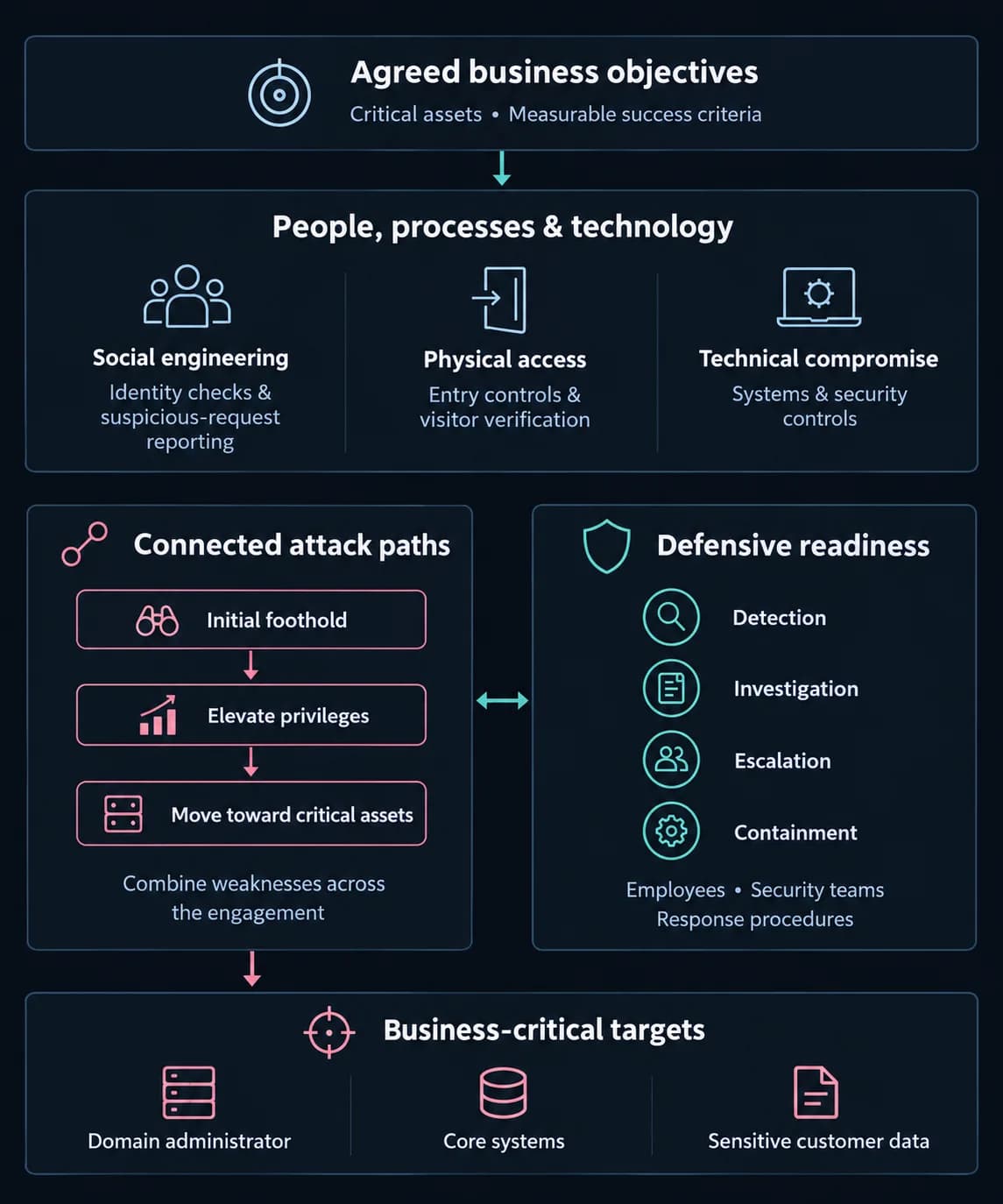
We assess how your people, processes, and technology work together to protect the assets and operations that matter most to your business. Guided by agreed objectives - such as gaining domain administrator privileges, reaching core systems, or accessing sensitive customer data - we simulate realistic attacks to determine whether an adversary could achieve meaningful business impact and whether your organization could detect and stop them.
- Agreed Targets and Success Criteria: We define clear objectives and measurable outcomes with your team, keeping the campaign focused on your business priorities.
- Full Attack Surface: We combine technical, physical, and social engineering vectors to test your people, processes, and technology together.
- Real-World Stealth: Our operators apply disciplined operational security and modern offensive tradecraft to assess both what an attacker could achieve and which actions your defenses observe.
- Detection and Response Readiness: We evaluate how quickly your security team detects, investigates, escalates, and contains activity, identifying gaps in visibility and response.
- Sustained Campaigns: Engagements run over weeks to months, allowing us to adapt to your defenses and assess resilience against persistent attackers.
Breach and attack simulation
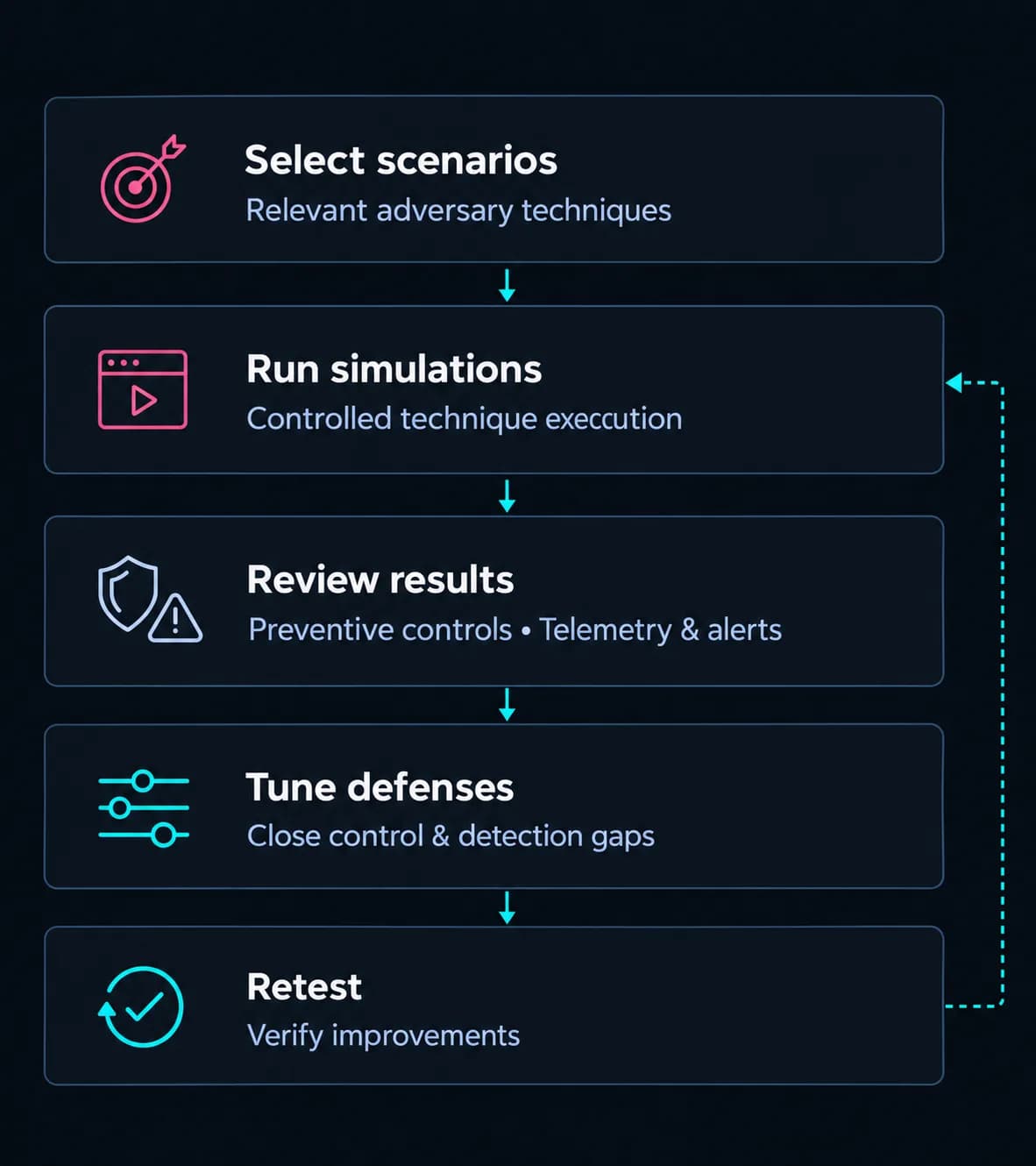
We run controlled simulations of selected adversary techniques to validate your security controls and detection coverage. Scenarios can focus on specific attack stages, helping your team identify gaps, tune defenses, and repeat testing to verify improvements.
- Focused Control Validation: Test how preventive and detective controls handle selected attack techniques.
- Visibility and Response: Check whether simulated activity generates useful telemetry and actionable alerts for your security team.
- Repeatable Testing: Rerun scenarios after changes to confirm improvements and identify regressions.
Controlled execution and collaborative follow-through
Every engagement follows agreed Rules of Engagement, with defined scope, permitted activities, escalation contacts, and stop conditions. We coordinate with your designated white team throughout testing, providing agreed progress updates while preserving the realism of the exercise and minimizing operational risk.
After testing, we review attack paths and defensive actions with your security team and prioritize remediation. A purple team debrief can include replaying selected techniques to validate detection improvements and strengthen response procedures.